
Marketing Consultancy
Digital Brand Strategy
Build a Digital Branding Strategy for Sustainable Success
Brand strategy is the blueprint for lasting success. By shaping long-term goals around the unique qualities that define your company, it creates a brand identity that stands out and evolves with purpose.
Brand strategy goes beyond logos and visuals—it defines how your business communicates, connects, and positions itself in the market. A strong strategy aligns your company’s vision, mission, and values with customer expectations, ensuring consistency across every touchpoint. It shapes how your audience perceives you, builds trust, and creates emotional connections that drive loyalty. By focusing on differentiation, relevance, and authenticity, a well-crafted brand strategy guides decision-making and fuels sustainable growth. It turns your brand into more than just a name—it becomes a powerful story, an experience, and a long-term asset that evolves with your business.
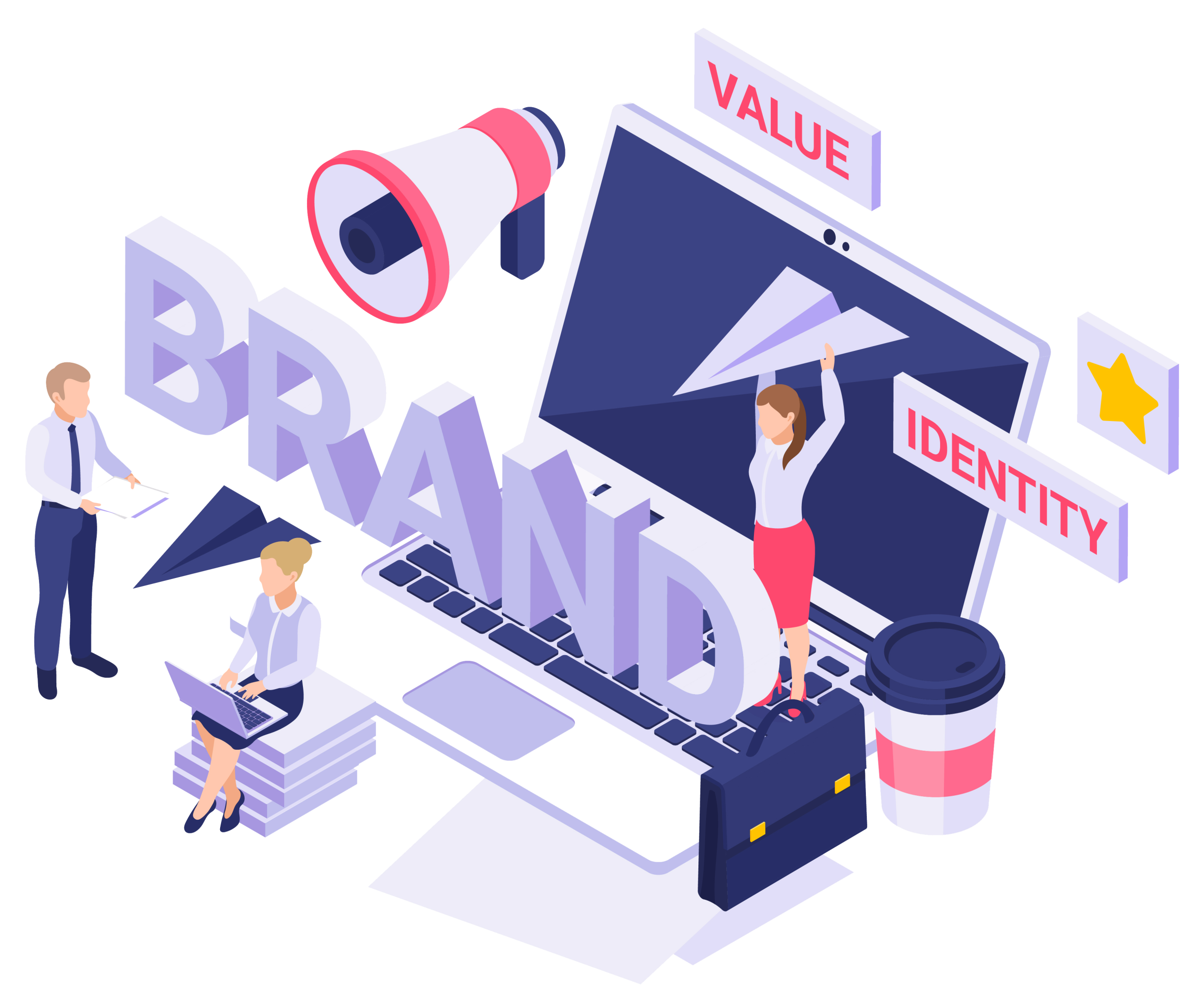
Step-by-Step Brand Strategy Development for Bangladesh
Reality check: Bangladesh is mobile-first, Facebook/WhatsApp heavy, price-sensitive, and trust-driven. Build for that context.
- Goal: Align brand with revenue model & growth targets.
- Actions: Define category, pricing, channels (retail, dealer, Daraz, D2C), 12-month OKRs.
- Deliverables: 1-page business thesis + quarterly targets.
- Goal: Focus on the few who matter.
- Actions: Create 2–3 ICPs (demographics, pains, triggers, objections).
- Bangladesh tip: Prioritize Bangla-first buyers; trust, COD, bKash/Nagad, and after-sales matter.
- Goal: Replace guesses with data.
- Actions: 10–20 interviews, analyze FB group comments, run IG/FB polls, review competitor reviews, keyword research (Bangla + English).
- Deliverables: Insight deck, top 5 pains, JTBD statements.
- Goal: Own a clear space in the market.
- Actions: Write a positioning statement (“For [ICP], [Brand] is the [frame of reference] that [benefit] because [RTB].”), map vs local competitors.
- Proof points: Warranty, local service network, certifications, case studies.
- Goal: Say the right thing, consistently.
- Actions: Message house (core promise, 3 pillars, proofs), funnel-stage CTAs (awareness→ conversion), tone rules (Bangla-first, English for B2B/LinkedIn).
- Offers: Free demo, WhatsApp chat, easy returns, installment/bKash pay.
- Goal: Memorable, readable, protectable.
- Actions: Check.com/.bd domain, basic trademark search, test Bangla/English readability at small sizes, color accessibility, favicon/social avatars.
- Deliverables: Mini brand kit (logo lockups, colors, fonts, usage rules) + 3 – 5 word tagline.
- Goal: Build demand, not just clicks.
- Actions: Pick 3–4 content pillars, 90-day calendar, video-first (reels/shorts), UGC/influencers, case studies, FAQs, bilingual SEO blogs, lead magnets.
- Distribution: FB/IG/TikTok, YouTube, GMB, email/WhatsApp.
- Metrics: Leads, CTR, CPL, ROAS, assisted conversions.
- Goal: Convert traffic efficiently.
- Actions: Fast, bilingual (Bangla/English), clear offers, WhatsApp/FB Messenger widget, GA4 + Meta Pixel, schema/local SEO, landing pages per campaign, FAQs & reviews, bKash/Nagad (if e-com).
- Targets: <2.5s LCP, CRO best practices, .com.bd for trust.
Non-negotiable: Measure and iterate monthly. Kill what doesn’t work, double down on what does.
What is digital Marketing?
Digital marketing is more than just a set of online activities—it is a unified effort that brings together the business development, marketing, and technology teams within an organization. Its purpose is to leverage every relevant digital medium—social platforms, search engines, email, websites, apps, and smart devices—to connect with the right audience at the right time. By combining creativity with data-driven insights, digital marketing builds awareness, engages prospects, and nurtures them through tailored funnels until they convert into loyal customers. At its core, it’s about using internet-based tools and strategies to drive measurable business growth.
Digital Marketing vs. Traditional Marketing: Key Advantages
- The most trackable and measurable type of marketing
- More cost-effective than traditional methods
- Provides clearer insights into ROI
- Flexible and scalable within any budget
- Enables precise targeting of the right audience
- Enhances overall conversion rates
- Expands your reach to a global audience
What are the common categories of
digital marketing?
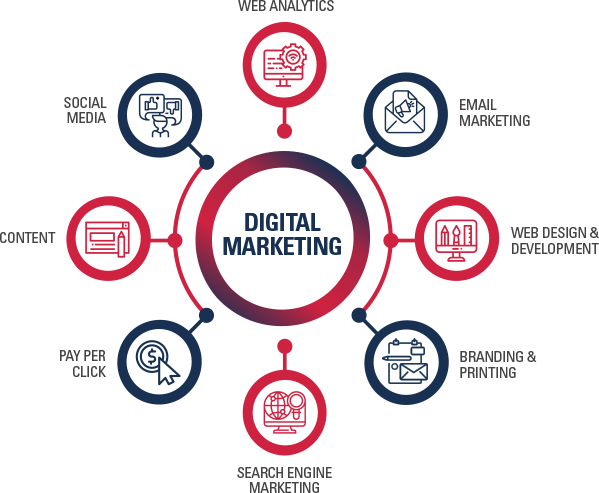
Promoting your brand, products, or services through social platforms like Facebook, Instagram, LinkedIn, YouTube, TikTok, and X (Twitter).
Creating and distributing valuable, relevant content (blogs, videos, infographics, guides) to attract and engage a defined audience.
Using video platforms like YouTube, TikTok, and Reels to create engaging content that educates, entertains, and converts.
Improving your website’s visibility on search engines like Google so your content ranks higher and drives organic (free) traffic.
Paid advertising on platforms like Google Ads and Bing Ads where you bid for keywords to reach targeted audiences instantly.
Building relationships and driving sales by sending targeted, personalized emails, newsletters, and campaigns.
Partnering with affiliates who promote your products/services for a commission on each sale or lead they generate.
Collaborating with influencers or thought leaders to promote your brand to their engaged followers.
Reaching audiences through SMS, push notifications, in-app ads, and mobile-optimized campaigns.
Banner ads, retargeting ads, and visual campaigns across websites and apps to increase brand visibility.
What exactly does a digital marketer do?
In broad term, any digital marketer takes care of digital communications with customers using the website, social media channels to generate leads and build brand awareness.
Can I Do My Own Digital Marketing?
Absolutely yes! Many entrepreneurs successfully manage their own digital marketing. The key is to learn the fundamentals first—understanding how different channels (SEO, social media, email, PPC, content, etc.) work together. Once you’ve built a foundation, you can start crafting a solid digital strategy tailored to your business.
There are plenty of online courses and resources available today that can help you get started. However, success won’t come from learning alone—you’ll need to put in consistent research and experimentation (R&D) to see what works best for your audience and industry.
In-House Professionals vs. Hiring a Digital Agency?
It’s a common debate—should you build an in-house marketing team or partner with a digital agency? Both approaches come with clear advantages and limitations.
Advantages of Hiring a Digital Agency
- Skilled Expertise: Agencies bring specialized talent across multiple digital channels.
- Industry Insights: They stay updated with the latest tools, trends, and strategies.
- Outsider Perspective: Agencies can identify opportunities and blind spots you may overlook internally.
- Scalability: Their services can expand or contract quickly based on your needs.
Advantages of Going In-House
- Deeper Business Knowledge: Internal teams fully understand your products, services, and customers.
- Aligned with Vision: They work closely with leadership, aligning with company mission and values.
- Focused on One Goal: The team’s energy is fully dedicated to your brand’s marketing objectives.
- Faster Internal Communication: Direct collaboration often speeds up execution.
Is internet marketing costly?
The cost of digital marketing varies depending on your business goals, company size, and sales targets. A startup looking for brand awareness will have a different budget requirement compared to an established company aiming for aggressive lead generation or nationwide campaigns.
For small and medium-sized businesses (SMBs), an integrated digital marketing budget generally ranges between BDT 20,000 to BDT 150,000 per month. This budget typically covers activities such as social media marketing, content creation, SEO, paid ads, and basic analytics
Thrive Growth Inside?
Learn effective Facebook marketing strategies, ad tips, audience targeting, engagement boosting, and maximizing ROI for business growth.